Ongoing promotion of water conservation with employees

At WT, water is primarily used across all operational sites for air conditioning circulation in office and warehouse areas, as well as for employee domestic needs. All water is supplied by local municipal utilities and sourced from freshwater systems. These operations do not pose a significant impact on local water resources or surrounding ecosystems.

To ensure the safety and quality of drinking water for employees, water dispensers are fitted with filters that are replaced monthly to effectively remove harmful substances. In addition, water quality is tested annually by SGS Taiwan to ensure it meets health and safety standards. Aside from evaporative losses from air conditioning system, where data is not practically measurable, other wastewater generated from daily employee use is discharged into municipal sewer systems through the building’s wastewater pipelines.

WT evaluates water-related risks using the World Resources Institute’s (WRI) Water Risk Atlas and has set a target to reduce water usage by 1% annually. According to the 2024 assessment, all disclosed operational sites were located in regions not classified as high or extremely high water stress areas. In 2024, the total disclosed water consumption was 23.62 ML (1,000 m³), covering operations in Taiwan, Hong Kong, South Korea, and China.

Water Resources Inventory Overview (Unit: ML)


Water Consumption
 
Water Discharge
17.01
17.01
2020
11.14
11.14
2021
12.95
12.95
2022
21.32
21.32
2023
23.62
23.62
2024

Note 1: The 2024 reporting boundary includes operational sites in Taiwan, Hong Kong, China, and South Korea. At certain office locations, water charges are embedded within property management fees and are not billed separately, rendering actual water usage estimations infeasible. As these locations account for an immaterial share of overall water consumption, they have been excluded from the disclosed figures.

Note 2: To enhance water resource management, WT has adopted the use of water meter readings from utility bills for statistical purposes starting in 2021. For years prior to 2020, water consumption was estimated based on water bills and unit pricing.

Note 3: Water usage includes evaporative losses from air conditioning systems and employee drinking water, which are considered immaterial and cannot be reasonably measured. All effluent is classified as domestic sewage and discharged directly into municipal sewer systems via the buildings’ infrastructure. As no flow meters are installed to capture actual discharge volumes, water discharge is assumed to equal water consumption for reporting purposes.

Water-saving Improvement Measures for Taiwan Headquarters’ Affiliated Park

Continuously replace water-saving devices/fixtures

Conduct inspections of water faucets and water usage patrols, and implement improvement plans for abnormal situations.

Strengthen promotion and dissemination of information related to water conservation to prevent inadvertent waste.

The water consumption of WT’s Zhonghe headquarters in Taiwan, as externally verified, was 12.28 ML in 2024, representing a 6.4% increase compared to 11.50 ML in 2023. The increase was primarily due to the annual cleaning of the cooling tower and additional water discharge required for tenant fire safety system inspections in 2024. WT will continue to coordinate with the building management committee to implement relevant water-saving improvement measures.

Water Use Verification

Water consumption data for the verified Zhonghe office in Taiwan over the past two years is as follows:

Year Total Water Consumption (ML) Water Intensity (ML/m²)
2023 11.4990 0.0006775
2024 12.2810 0.0007235

Note: The inventory scope for both 2023 and 2024 covers the Zhonghe headquarters office in Taiwan. Verification for 2025 has been commissioned to the British Standards Institution Taiwan (BSI Taiwan).
 

Continuously raising awareness and implementing water conservation measures

The water intake at WT's operating sites are mainly used for circulated water of air conditioners and daily-life water consumed by employees in office and storage areas. The water is entirely sourced from the local water companies (fresh water) where each operating base is located, with no significant impact on water resources and the ecological environment of water source areas.


In order to ensure drinking water safety for employees, the water dispenser filters are replaced every month to effectively remove harmful substances in the water. Taiwan SGS is commissioned to regularly test the water every year to ensure safe and healthy water quality. The water consumption is mainly contributed by the evaporation and drift losses from air-conditioners and the water drunken by employees, and there is no effective tool available to measure them. The water discharge is solely made up of water used by employees in the daily life and is discharged into local public sewage systems through the sewage pipes of the building. WT conducts assessments using the World Resources Institute (WRI) Water Risk Atlas and has set a target to reduce water consumption by 1% annually.


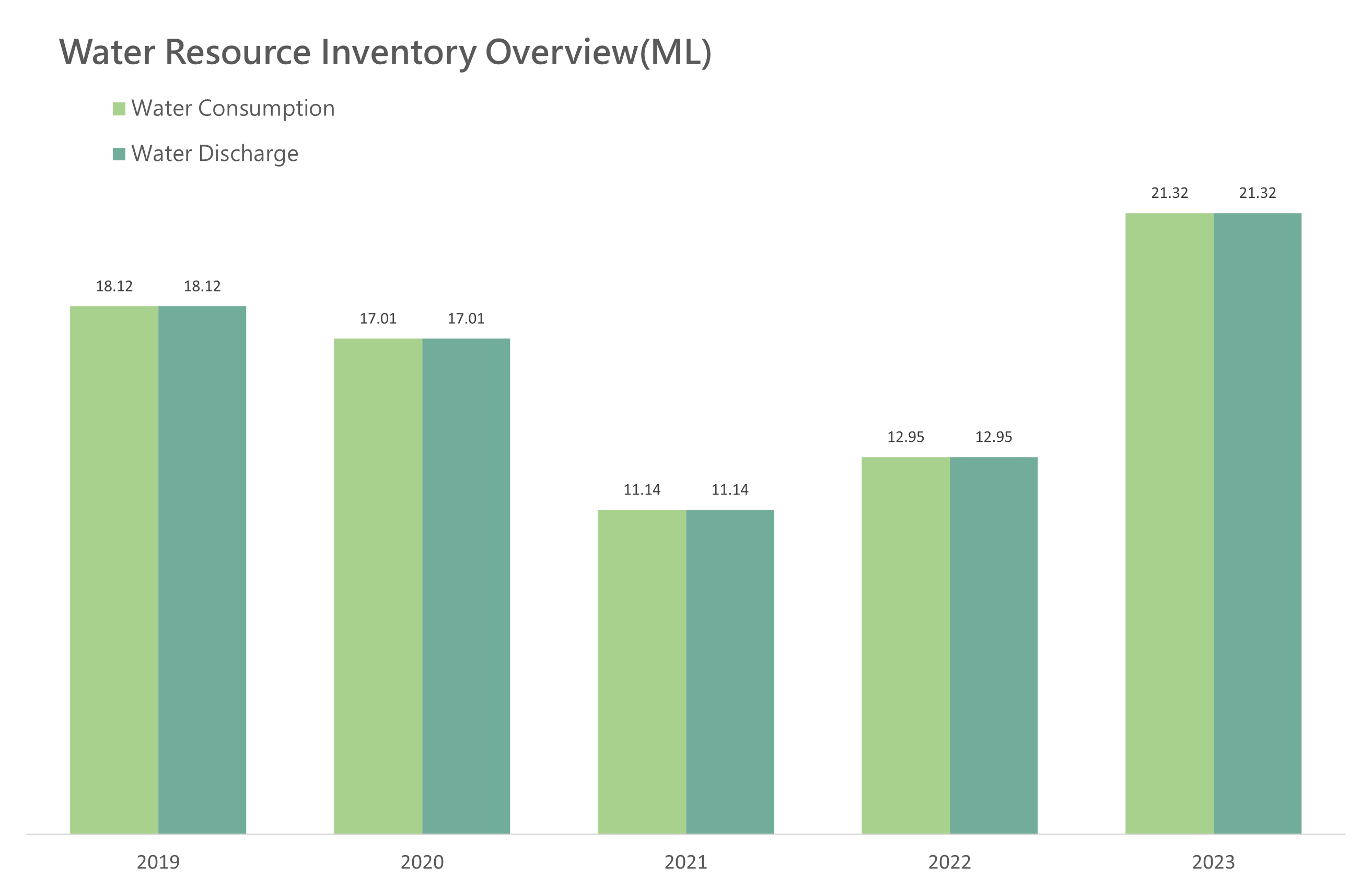
In 2023, operational locations included in the disclosure inventory were Taiwan, Hong Kong, Korea, and China, with a total water consumption of 21.32 ML, an increase of 8.37 ML compared to 2022, due to the expanded statistical scope.


Note 1: The 2023 statistical boundary covers all operational locations in Taiwan, Hong Kong, China, and Korea. Water fees for some offices are included in management fees without separate payment, making it impossible to reasonably calculate actual water consumption. As these represent an extremely small proportion of total water consumption, they are not included. 

Note 2: To implement water resource management, from 2021 onwards, statistics are based on water consumption figures shown on water company bills. For years prior to 2020, consumption was estimated based on water fees and unit prices.

Note 3: Water consumption includes air conditioning water evaporation and employee drinking water needs. As these amounts are not significant and lack reasonable statistical methods, they are not separately tracked. All wastewater is domestic sewage directly discharged from office buildings to domestic sewers without flow measurement capabilities, so water consumption is used to estimate discharge volume for disclosure purposes.


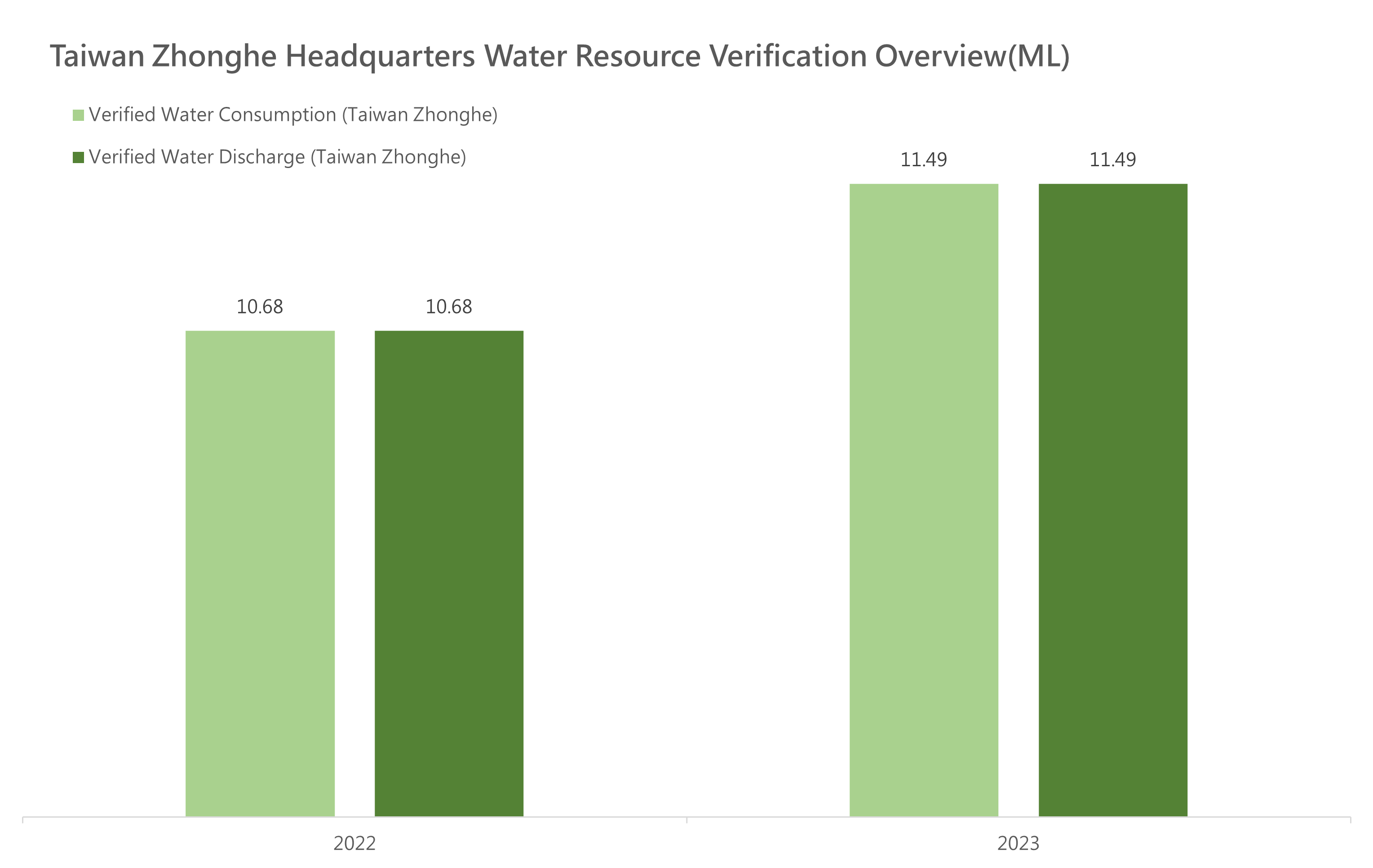
To ensure the accuracy of water usage data, the water consumption of the Zhonghe Headquarters in Taiwan for 2022 and 2023 has been verified by BSI Taiwan Branch. The 2023 water consumption was 11.49 ML, an 8% increase compared to the 2022 figure of 10.68 ML. This increase was due to the 2023 cooling tower repairs and updates, which required large amounts of water drainage. WT has been continuously communicating with the building management committee to implement relevant water conservation measures.


Note: The verification scope for 2022 and 2023 was the Zhonghe Headquarters office in Taiwan. Water consumption data for 2022 and 2023 was verified by BSI Taiwan Branch in May 2024.


In the future, WT will continue to promote water conservation measures, use water-saving devices, conduct water usage inspections, and regularly promote water conservation information to achieve the goal of zero water waste together with employees.


Active implementation and education have achieved remarkable results in water conservation

The water intake at WT’s operating bases in Taiwan are mainly used for circulated water of air conditioners and daily-life water‭ ‬consumed by employees in office areas‭. ‬The water is entirely sourced from the local water companies‭ (‬fresh water‭) ‬where each operating base is located‭, ‬and no water is taken from sea water‭, ‬surface water‭, ‬ground water or water generated by other organizations‭. ‬In order to ensure drinking water safety for employees‭, ‬the water dispenser filters are replaced every month to effectively remove harmful substances in the water‭. ‬Taiwan SGS is commissioned to regularly test the water every year to ensure safe and healthy water quality‭. ‬Except for the evaporation and drift losses from air-conditioners‭, ‬all the water used by employees in the‭ ‬daily life is discharged into local public sewage systems through the sewage pipes of the building‭. ‬An assessment conducted by WT following the Water Risk Atlas of the World Resources Institute‭ (‬WRI‭) ‬found that the operating bases in Taiwan‭, ‬Hong Kong‭, ‬and‭ ‬Singapore are not in areas with water stress‭ (‬high or extremely high‭).‬

The water intake was 12.95‭ ‬million liters‭ (‬ML‭) ‬in 2022‭, ‬an increase of 1.81‭ ‬ML compared to 2021‭, ‬mainly due to the inclusion of‭ ‬the Hong Kong logistics center‭, ‬and the surging number of employees returning to the office from working-from-home after the COVID-19‭ ‬pandemic peak‭. ‬As the evaporation and drift losses of circulated water in air-conditioners are impossible to measure effectively‭, ‬they were ignored as consumption in the reported discharge‭. ‬The amount of water discharged was also 12.95‭ ‬ML in 2022‭, ‬and the water consumption was 0‭ ‬ML excluding the losses that were impossible to measure‭. ‬In 2022‭, ‬the Taiwan headquarters continued to communicate with the management committee of the park where the offices are located to implement relevant water-saving measures‭.‬

Effective water conservation through promotion and implementation

The main uses of water resources at each of WT Taiwan’s operating bases are recycled water for air-conditioning in office areas and water for employees’ daily use. The water discharged is mainly employees’ domestic sewage, which is discharged into the building’s pipeline and then enters the sewer system. The evaporation of water for air-conditioning is the main reason for consumption. As there is no valid statistical method for water discharge and water consumption, only the amount of water withdrawn is disclosed. Water withdrawal in 2021 is 11.14 million liters (ML), a decrease of 5.87 ML compared to 2020. This is mainly due to a 34.52% reduction in office attendance due to the implementation of work from home measures for COVID-19 and a 42.38% reduction in water withdrawal intensity compared to 2020.


In 2021, WT has continued to use various means to promote information on water conservation, prioritizing the procurement of water-using equipment with water-saving labels, and regularly deploying staff to inspect whether there are any water leaks, in the hope of implementing water conservation practices in people’s daily life, so as to maximize the effectiveness of water resources.


1: The inventory boundary covers WT Microelectronics, Morrihan International Corp., Techmosa International Inc., Maxtek Technology Co., Hongtech Electronics Co., Nuvision Technology, Inc., Brillnics (Taiwan) lnc., WT Joint Staff Welfare Committee, and other operating bases in Taiwan, in which 12 offices are added in Zhonghe and Hsinchu in 2021.
2: In order to implement water resources management, the amount of water consumption is recorded in the water company’s bills from 2021 onward, and water charges and unit prices are used for estimation in the years before 2020. The water charges for the Taichung office are apportioned according to the proportion of the management fee charged by the building management committee where the office is located, so the actual water consumption cannot be accurately determined, and the proportion of the total water intake is extremely low, so it is not included.
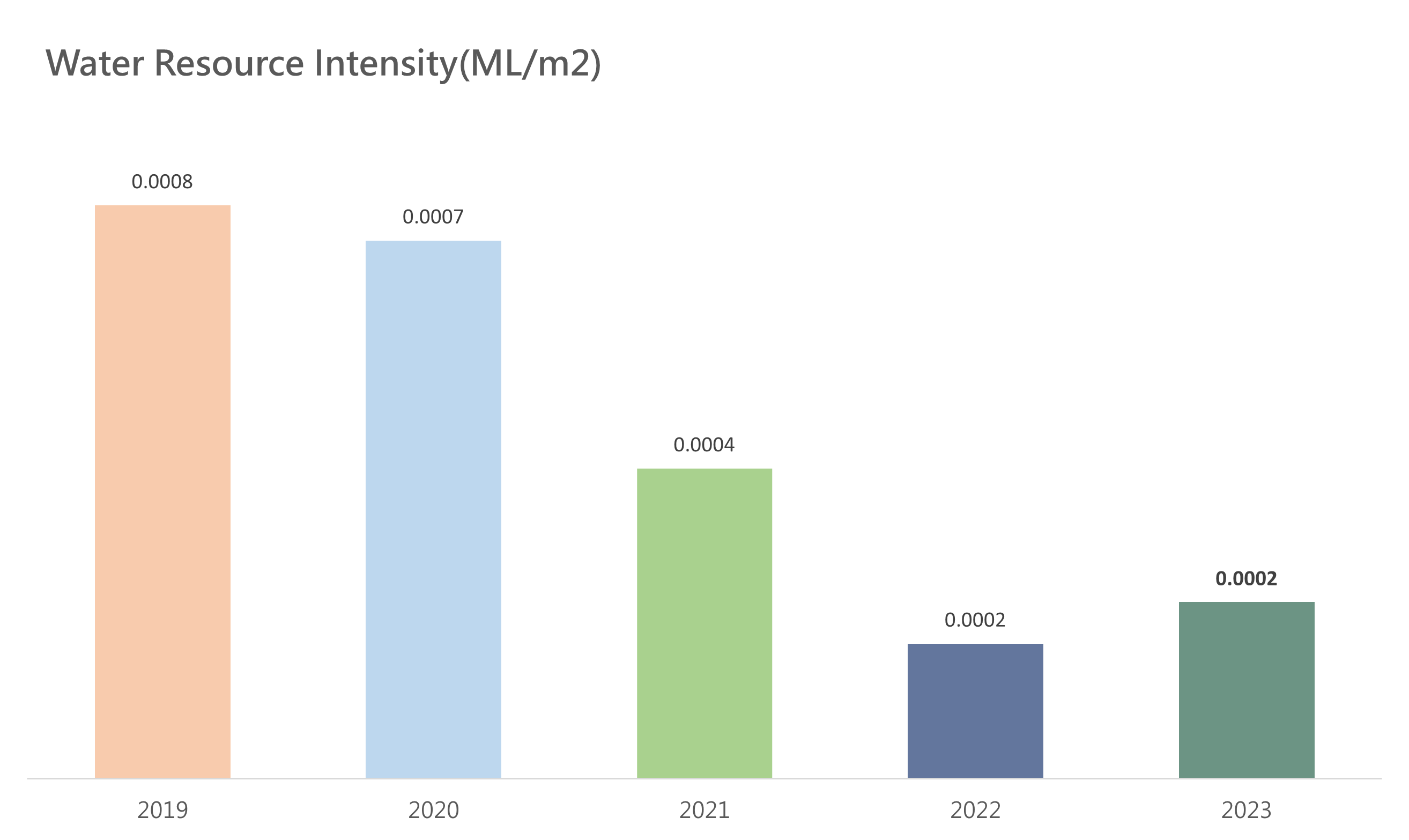
3: The denominator used for the water intensity is the floor area; please refer to Note 7 of the greenhouse gas emission intensity.