WT values the welfare and rights of its employees and actively promotes harmonious relations between management and laborers. Work rules and various management regulations have been formulated in accordance with the Labor Standards Act and relevant laws and regulations, and the Code of Practice for Sustainable Development has also been formulated to specify the rights and obligations of both employers and employees in management matters, so that employees can fully understand, comply with, and protect their legitimate rights and interests. In the case of any major changes in the operating conditions that may affect employees’ rights and interests or work environment, WT informs employees within the statutory minimum notification period to protect employees’ rights and interests.
Implementing human rights risk assessment to create a suitable workplace
WT formulated, in accordance with international human rights conventions and initiatives, a Social Policy and Code of Conduct, which was signed by the Chairman and published on the Company’s official website as a standard for all employees, customers, suppliers and other stakeholders to follow.
WT’s human rights policies are in line with:
| 01 | Universal Declaration of Human Rights |
| 02 | United Nations Global Compact, UNGC |
| 03 | Declaration of Fundamental Principles and Rights at Work |
| 04 | International Labour Organization (ILO) Conventions |
In 2024, a human rights risk assessment covering 13 items in five categories was carried out at WT and found no high-risk employees. In addition, as no high-risk situations were identified in the assessment, no corrective actions were planned. Furthermore, no complaints were received, nor were any human rights violations detected; therefore, no remediation measures for human rights violations were required in 2024. In addition, WT continues to raise the awareness of human rights issues for all employees through various education and training mechanisms, including education in pre-employment orientation for new employees, and through the WT e-Learning Academy, where employees can browse relevant online courses at any time.
In addition, to ensure a discrimination-free and harassment-free workplace, WT trains all employees of the Group on human rights issues in the four major aspects of the Social Policy and Code of Conduct, which are labor rights, health and safety, ethics, and management systems. In 2024, a total of 3,449 current employees (including 15 contractor employees) have received the human rights training, including 232 new hires at operating bases in Taiwan and China and 3,217 others who required regular refresher training (100% pass rate).
Note: The Company completed the acquisition of Future Electronics on April 2, 2024. As a result, training activities conducted in 2024 did not include Future Electronics. Full integration is planned to begin in 2025.
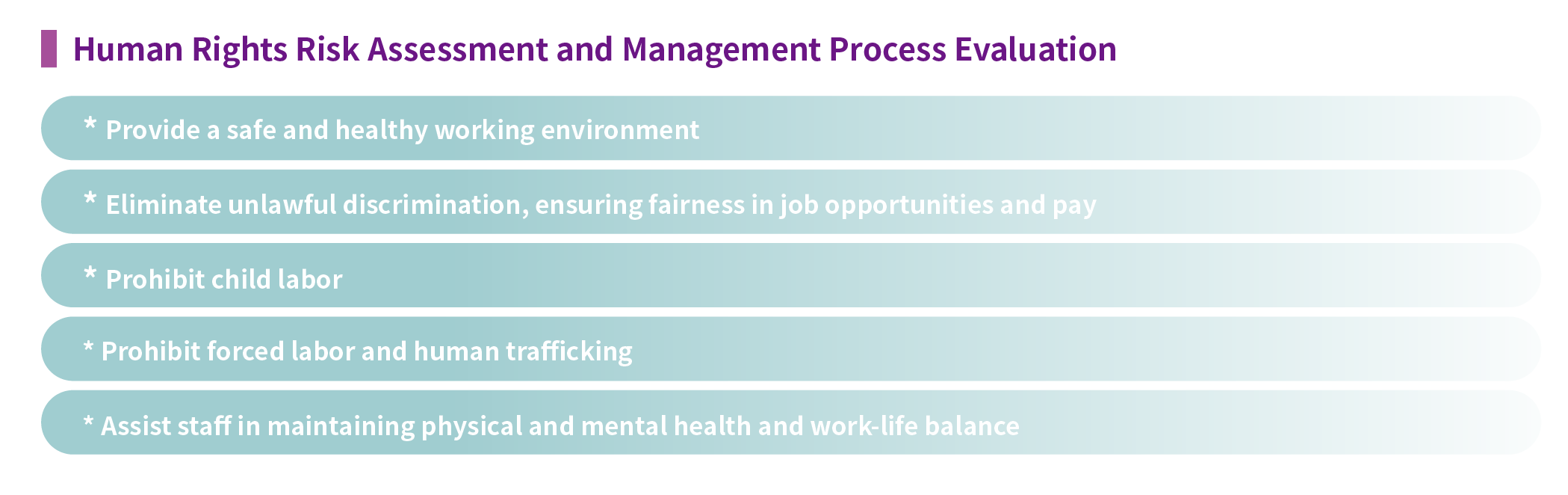
| Implementation policy | Assessment Items | Affected group | High risk population |
|---|---|---|---|
| Provide a safe and healthy work environment | 1. Employee occupational safety and health 2. Physical workplace safety 3. Employee health management and medical consultation 4. Health care and emergency notification |
Employees | 0 person |
| Eliminate unlawful discrimination and ensure fairness in job opportunities and pay | 1. Diversity and equality in recruitment, promotion and rewards 2. Promotion is evaluated based on employee performance and professional skills |
Employees | 0 person |
| Prohibit child labor | 1. Diversity and equality in recruitment, promotion and rewards 2. Promotion is evaluated based on employee performance and professional skills |
No child labor | 0 person |
| Prohibit forced labor and human trafficking | 1. No slavery or forced labor 2. Regulations and practices on overtime work and women’s night work 3. Effective controls on attendance and overtime |
Employees | 0 person |
| Assist employees in maintaining physical and mental health and work-life balance | 1. Provision of breastfeeding related facilities for nursing employees 2. Provision of diverse clubs and company activities to establish a work-life balance. |
Employees | 0 person |
Offering multiple channels for smooth communication
WT provides a good platform for communication so that all relevant parties can access the stakeholders’ section on the Company’s official website. Employees may express their opinions to HR via email, telephone calls or in writing to communicate with the Company in two-way with regard to problems or concerns they encounter in work systems and environments. Each responsible unit will properly handle and provide feedback or improvement solutions to achieve effective communication. In 2024, none was received through the Company website and internal channels. See “2-7 Ethical Corporate Management” for details. In addition, regular executive and departmental meetings are held, and employees kept informed of operational changes that may have a significant impact on them by means of announcements. As of the end of 2024, employees’ rights and interests are well protected and there have been no major employer-employee disputes or negotiations. With good communication and interaction between the two parties, it is believed that a harmonious labor relations in the future will be sustained.
An incentive scheme more generous than legally required to maximize values
WT continues to monitor the gender pay ratio and aims to reduce the gap through effective management practices.
WT respects gender fairness and equality in pay. Nevertheless, an analysis of the existing employee makeup found that male employees are mostly in sales positions, which have a reward system for performance bonuses, or in application engineering related positions, which also have a higher pay due to the external salary benchmark; while female employees are mostly in logistics positions providing support for operations. The gender pay gap is mainly caused thus by different remuneration structures for different functions. WT will continue to improve the gender ratio of STEM (technology, engineering and other occupations) and optimize the gender makeup of all functions to close the gender pay gap.
| Taiwan | China | |||||||
|---|---|---|---|---|---|---|---|---|
| Category | Basic Salary | Annual Total Pay | Basic Salary | Annual Total Pay | ||||
| Female | Male | Female | Male | Female | Male | Female | Male | |
| Senior manager | 1 | 1.12 | 1 | 1.07 | 1 | 1.02 | 1 | 1.04 |
| Junior manager | 1 | 1.13 | 1 | 1.22 | 1 | 1.11 | 1 | 1.20 |
| Nonexecutive | 1 | 1.06 | 1 | 1.11 | 1 | 1.33 | 1 | 1.42 |
Note 1: Senior managers refer to division heads or above, junior managers refer to associate managers or other managers, and non-executives refer to all other employees. Note 2: WT Group (excluding Future Electronics) discloses data from key locations such as Taiwan and China based on employee headcount and operational scale. Furthermore, the ratio of female to male compensation is disclosed to demonstrate the Company’s commitment to gender equality and pay equity.
Variable performance bonuses are distributed to share surplus results with employees
In the five major regions where it operates, WT’s standard entry-level pays are 1.00 to 2.20 times the local legal minimum wages. There is no gender difference in standard entry-level pays at WT. In addition, as required by SASB Standards, the entry-level basic pays at WT’s five logistics centers are 1.16 to 2.20 times the local legal minimum.
| Region | Taiwan | Shenzhen | Hong Kong | South Korea | Singapore | Canada | United Kingdom |
|---|---|---|---|---|---|---|---|
| Standard minimum pay for all entry-level personnel ÷ legal minimum wage | 1.02 | 2.20 | 1.58 | 1.50 | Not applicable | 1.00 | 1.02 |
| Logistics center | Taiwan | Shenzhen | Hong Kong | South Korea | Singapore | MADC | EMEADC |
| (Two Logistics center) | (Canada) | (Germany) | |||||
| Actual minimum pay for entry-level personnel in the logistics center ÷ legal minimum wage | 1.16 | 2.20 | 1.58 | 1.54 | Not applicable | 2.48 | 1.18 |
Note: Singapore has no minimum wage laws or regulations.
Variable performance bonuses are distributed to share surplus results with employees.
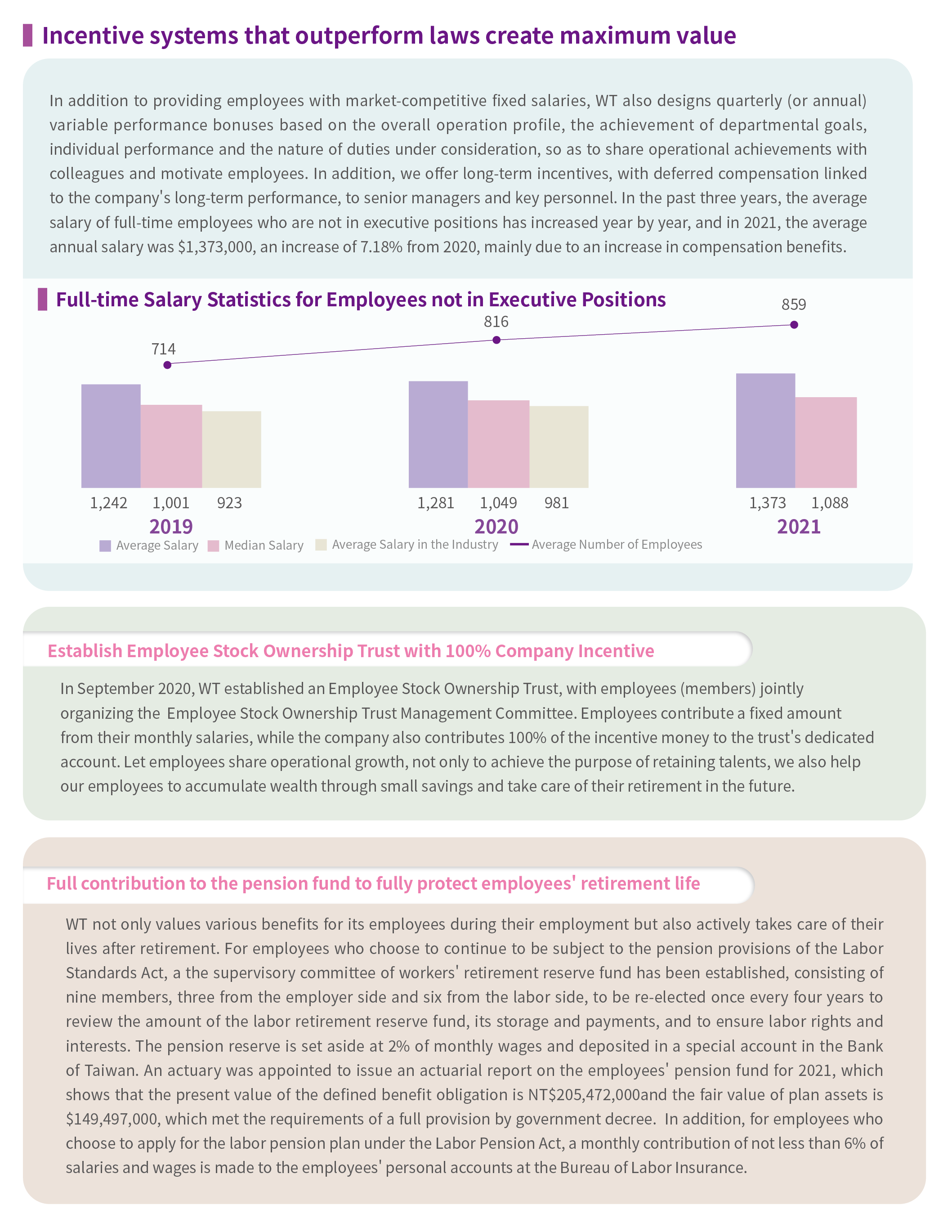
In addition to providing employees with market-competitive fixed salaries, WT designs quarterly (or annual) variable performance bonuses based on the overall operation profile, the achievement of departmental goals, individual performance and the nature of duties, so as to share operational achievements with employees and motivate them. WT also offers long-term incentives, with deferred compensation linked to the company’s long-term performance, to senior managers and key personnel. The average salary was NT$1,426,000 in 2024, 2.44% higher than in 2023. The median salary was NT$1,132,000 in 2024, 1.34% higher relative to 2023. It has increased for six consecutive years, an increase of 13.09% from 2019.
Pay for full-time non-executives, 2019-2024 (in NTD thousand)
| Pay for Full-time Non-executives | 2019 | 2020 | 2021 | 2022 | 2023 | 2024 |
|---|---|---|---|---|---|---|
| Average no. of Employees | 714 | 816 | 859 | 940 | 931 | 936 |
| Average Pay | 1,242 | 1,281 | 1,373 | 1,425 | 1,392 | 1,426 |
| Median Pay | 1,001 | 1,049 | 1,088 | 1,096 | 1,117 | 1,132 |
| Average Pay in the Sector | 923 | 981 | 1,110 | 1,120 | 1,041 | 1,070 |
Note: The term “not holding a managerial position” refers specifically to individuals who are not designated as managerial officers in the Company’s Annual Report. 。
Employee stock ownership trust is established with 100% company incentive.
In September 2020, WT Taiwan headquarters established an Employee Stock Ownership Trust, with employees (members) jointly organizing the Employee Stock Ownership Trust Management Committee. Employees with one year of experience are free to participate. As of the end of 2024, 90% of eligible employees are participants. Employees contribute a fixed amount from their monthly salaries, while the Company also contributes 100% of the incentive money to the Trust’s dedicated account. By allowing employees to share in operational growth, the Trust not only retain talents as intended, but also help employees to accumulate wealth through small savings and secure their pensions in the future.
Full contribution is made to the pension fund to protect employees’ retirement life.
People-oriented WT not only values benefits for its employees during their employment but also actively takes care of their lives after retirement. The Supervisory Committee of Employee Retirement Reserve Fund was established for employees of WT individual companies who choose to stay in the pension scheme of the Labor Standards Act. The Committee is composed of nine members, of whom three represent the employers and six represent the employees, and is re-elected once every four years. The Committee reviews and approves the amount of the employee pension fund and its deposits and payments to ensure labor rights and interests. The pension reserve is set aside at 2% of monthly wages and deposited in a special account in the Bank of Taiwan. An actuary was commissioned to issue an actuarial report on the employees’ pension fund for 2024, which shows that the present value of the defined benefit obligation is NT$211,891,000 and the fair value of plan assets is NT$179,145,000, which met the requirements of a full provision by government decree. In addition, for employees who opted for the labor pension plan under the Labor Pension Act, a monthly contribution of not less than 6% of pay is made to the employees’ personal accounts at the Bureau of Labor Insurance.
WT Pension Scheme by Region
| Region | Pension Scheme | Employer Contribution | Employee Contribution |
|---|---|---|---|
| Taiwan | Defined Benefit Pension Plan | 2% of the wage is set aside monthly for pension reserve | No regulations |
| Defined Contribution Pension Plan | 6%, capped at NT$9,000 | 0 to 6 %, depending on personal choice, capped at NT$9,000 | |
| Shenzhen | Endowment Insurance | 16% for local residents, 15% for the others | 8% |
| Shanghai | 16% | 8% | |
| Beijing | 16% | 8% | |
| Hong Kong | Mandatory Provident | 5%, capped at HK$1,500 | 5%, capped at HK$1,500 |
| South Korea | National Pension | 4.5%, capped at ₩277,650 | 4.5%, capped at ₩277,650 |
| Retirement Pension(Defined Contribution) | 8.33% of annual salary | No regulations | |
| Singapore | Central Provident Fund | 7.5% to 17%, depending on age, capped at S$1,156 | 5% to 20%,depending on age, capped at S$1,360 |
| Canada | Deferred Profit Sharing Plan | 0.5% to 3.5% of gross earnings based on years of service, capped at CAD 5,000. | No regulations |
| United Kingdom | People’s Pension | 4% | 5% |
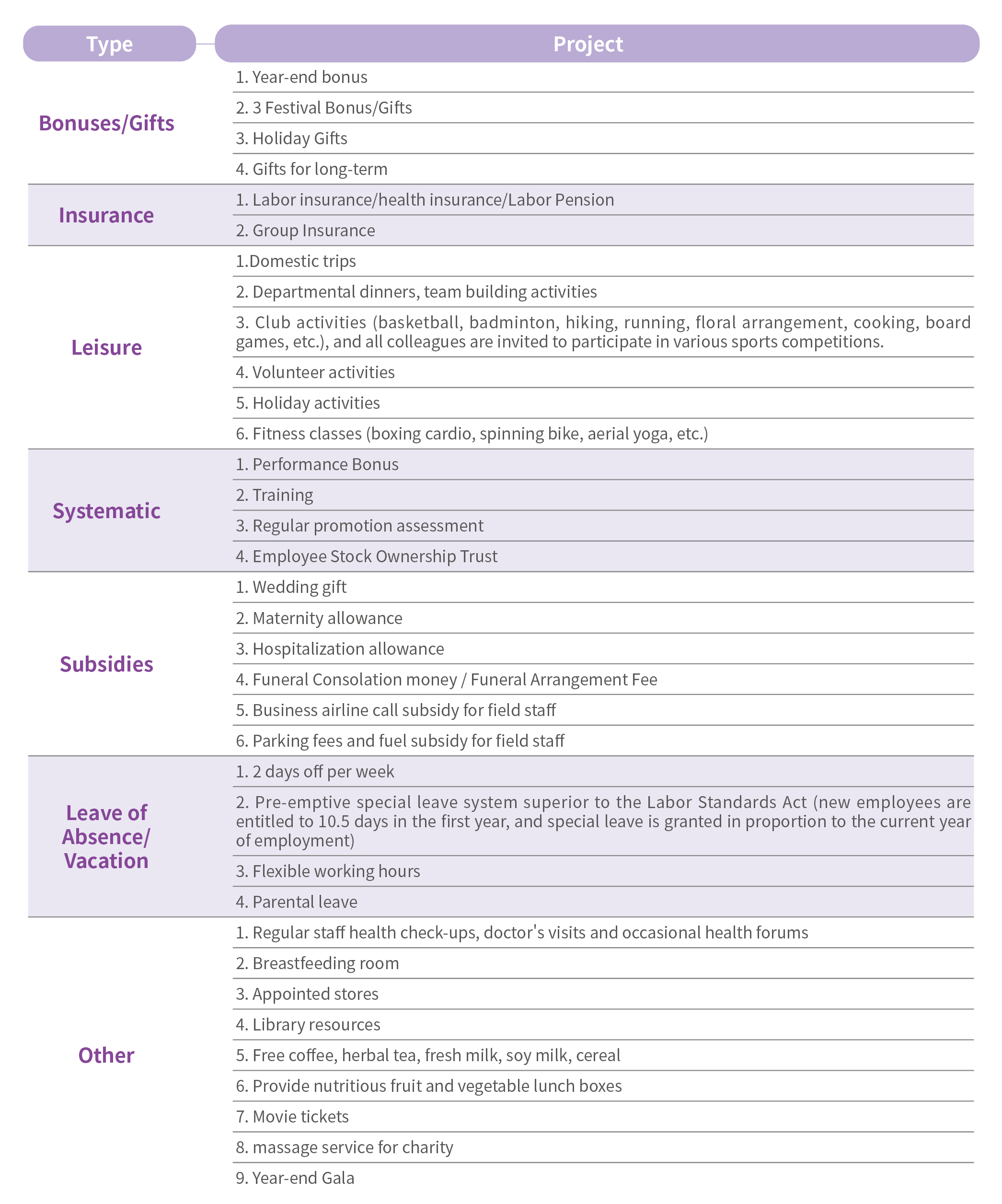
WT believes that only by providing employees with a secure work environment and a fair welfare system can employees fully contribute their talents without any worries and thus create maximum value. The benefits provided to the entire Group’s full-time employees in 2024 included group insurance, wedding gift money, maternity allowance, consolation money, health checkups, holiday gifts, company outings, departmental and club activities, seminars, and welfare items. The spending on employee benefits, including overseas regions, was approximately NT$95.93 million.
| Type | Project |
|---|---|
| Bonuses / Gifts | 1. Year-end bonus 2. Three festivals bonus / gifts 3. Holiday gifts |
| Insurance | 1. National Labor Insurance / National Health Insurance / Labor Pension 2. Group insurance |
| Leisure | 1. Domestic trips 2. Departmental dinners, team building activities 3. Club activities, and sports competitions open to all employees, vendors, customers, and peer companies 4. Volunteer activities 5. Holiday activities 6. Fitness classes (Soothing yoga, energetic aerobics, aerial yoga, etc.) |
| Scheme | 1. Performance bonus 2. Training 3. Regular promotion assessment 4. Employee Stock Ownership Trust |
| Subsidies | 1. Wedding gift 2. Maternity allowance 3. Hospitalization allowance 4. Funeral consolation money / funeral arrangement fee 5. Telephone bill subsidy for field staff 6. Parking fees and fuel subsidy for field staff 7. Monthly electricity subsidy for electric vehicles (EVs) |
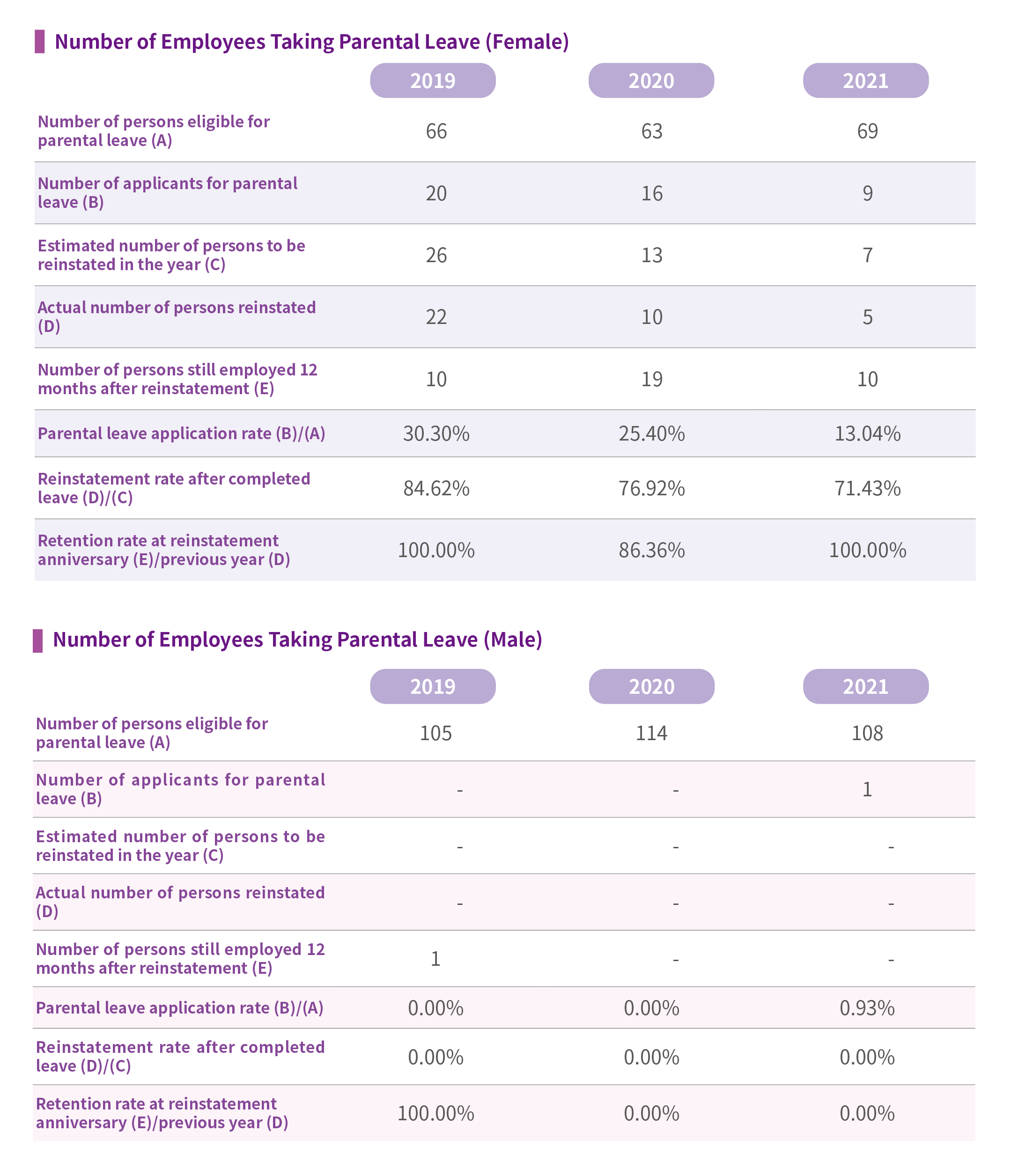
| Leave of Absence / Vacation | 1. Two days off per week 2. Pre-emptive special leave system (new hires are entitled to 10.5 days in the first year, and special leave is granted in proportion to the current year of employment) * 3. Flexible working hours 4. Parental leave 5. New Hire Vitality Leave (Employees are entitled to 1.5 days of “New Hire Vitality Leave” upon completion of their probationary period. After reaching one full year of service, they are granted an additional 1.5 days, totaling 3 days of leave.) * |
| Other | 1. Regular employee health checkups, doctors’ visits and occasional health forums 2. Nursing room 3. Stores providing WT special offers 4. Library resources 5. Free coffee, herbal tea, fresh milk, soy milk, and cereal 6. Provision of healthy breakfast, nutritious fruits, and vegetarian lunch boxes 7. Year-end Gala |