Integrity is WT’s most important core value and guiding business principle. The Group’s management and all employees are expected to adhere to clear ethical standards and moral conduct. This commitment extends to shareholders, banks, customers, employees, original manufacturers, and other suppliers, and represents a fundamental requirement for WT to maintain its competitive advantage and act in the right way.
Committed to ethical standards and a transparent and responsible corporate culture
WT formulated the Social Policy Code of Conduct, UNCAC Anti-corruption Policy, and United Nations Sustainable Development Goals Policies, Anti-corruption, Anti-bribery and Anti-money laundering Policy. These policies align with international corporate governance standards and anti-corruption frameworks. The social policies and codes of conduct apply to the Board members, the Group’s employees, independent contractors, suppliers, and all those who do business with WT.
In addition, The Ethical Corporate Management Best Practice Principles, Procedures for Ethical Management and Guidelines for Conduct, Codes of Ethical Conduct, and Supplier Code of Conduct that the Board has adopted are available in either the Corporate Governance section or Sustainability Report section of the Company’s official website and the Intranet in Traditional Chinese, Simplified Chinese and English. Information on Ethical Values and Professional Code of Conduct and Insider Trading Prevention Education and Advocacy are made available on the Intranet for all employees’ reference. In addition, relevant personnel are also appointed to participate in lectures and symposiums held by industrial associations or professional groups, so as to strengthen the Group’s ethical operation policies.
Regular refresher training on Code of Conduct to raise ethics awareness among all employees
As part of the Group’s annual refresher training on “Ethical Values and Code of Conduct”, a total of 3,217 employees, including full-time staff, contract-based personnel, and contractor employees, completed the training and passed the assessment during the course period from September 2 to September 30, 2024, achieving a 100% pass rate.
The training and assessment covered a wide range of compliance topics, including ethical self-regulation, intellectual property rights, data protection, accurate communication, export control, anti-corruption, unfair advantage, fair competition and antitrust, conflict of interest, insider trading, whistleblowing and protection against retaliation, and disciplinary measures.
In addition, new hires are introduced to core governance and compliance policies during their onboarding training, including the Corporate Governance Best Practice Principles, Sustainable Development Best Practice Principles, Ethical Corporate Management Best Practice Principles, Code of Ethical Conduct, Procedures for Ethical Management and Guidelines for Conduct, and the Supplier Code of Conduct. They are also required to complete the online “Social Policy & Code of Conduct” training and pass the associated test within seven days of employment. Outside of the annual refresher period (September 2 to 30, 2024), a total of 232 new hires completed and passed the required training.
In 2024, the total training hours for ethics-related education reached 3,449 hours, with 3,449 participants in total, including 3,434 full-time employees (accounting for 99.57%) and 15 contractor employees (accounting for 0.43%).
| Required Participants | Completed Participants | Remarks | |
| Full-time employees | 3,434 | 3,434 | The acquisition of Future Electronics was completed on April 2, 2024. As a result, the 2024 training program did not yet include Future Electronics employees. Full inclusion will begin in 2025. |
| Contract-based staff | 0 | 0 | No contract-based employees were on board during the training period. |
| Contractor employees | 15 | 15 |
Ethical Management Team
Implement ethics management and strengthen risk control
To improve ethical management, the Ethical Management Team was jointly formed by HR, Legal and Auditing office, and headed by the Chief Human Resources Officer. Each department is responsible for making ethical management policies, formulating and implementing relevant measures, and handling reporting procedures within their functions and responsibilities to ensure the implementation of the Ethical Corporate Management Best Practice Principles.
Ethical corporate management and anti-corruption practices
Integrity is one of WT’s core values. We uphold this principle through our ethics management practices and anti-corruption mechanisms, with the following concrete actions in place:
Implementation Measures:
1. An Ethical Management Team conducts annual training sessions for all employees, including new hires, to promote awareness of ethics policies and anti-corruption regulations.
2. Each business unit is responsible for regularly monitoring and reviewing unusual circumstances as part of daily operations. This includes periodic account reconciliation and site visits with suppliers, surveillance of suspicious transactions, detection of shell companies, irregular payment activities, and abnormal changes in logistics or delivery locations.
3. High-risk operations are prioritized in the Company’s annual audit plan to ensure effective oversight.
4. The Chief Human Resources Officer reports the implementation results of ethics management to the Board of Directors on a regular annual basis.
WT has established rigorous control mechanisms for business activities and operational procedures that are potentially exposed to higher risks of unethical conduct. In addition to the regular monitoring and review of processes with a higher risk of corruption – such as those susceptible to improper benefits, bribery, or other unethical practices – the internal audit personnel also prioritize high- risk operations in the annual audit plan based on risk assessments, thereby reducing the likelihood of unethical or corrupt behavior. Furthermore, each department and subsidiary conducts annual self-assessments of internal controls to review and evaluate the effectiveness of the design and implementation of the internal control system.
The Ethical Management Team reports annually to the Board of Directors on the implementation results of the Company’s ethics management efforts for the previous year. On January 14, 2025, the report was submitted to the Board, covering topics such as training on ethical values and professional conduct, whistleblowing cases related to ethical misconduct, and the prevention of insider trading. These report assists the Board in evaluating the effectiveness of the Company’s preventive mechanisms for ethical business practices.
No involvement in political-related initiatives and no political donations
WT has not made any direct or indirect donations to political activities, political parties/associations/NGOs, politically-related organizations, individual politicians, or other voting/referendum initiatives in the past five years. The amount of political donations has been NT$0. In addition, WT has not lobbied on specific issues or conducted related activities with interest representative groups.
Strict regulatory compliance with zero violations
WT strictly adheres to all applicable regulations in every location where it operates. Across all its operational sites, the company has recorded zero incidents of regulatory violations in the areas of economic (such as investment, securities, and taxation), environmental (including air pollution, wastewater, and waste management), and social aspects (including human rights and occupational injuries).No penalties or sanctions have been imposed by the competent authorities.
| Types of Ethical Conduct | Number of Cases Identified or Reported | Number of Substantiated Cases After Investigation |
|---|---|---|
| Corruption or Bribery | 0 | 0 |
| Discrimination or Harassment | 0 | 0 |
| Conflict of Interest | 0 | 0 |
| Money Laundering or Insider Trading | 0 | 0 |
| Other | 3 | 0 |
Note: WT operates under a B2B business model. Transaction data with customers does not contain personally identifiable information of the customers or their contacts. Therefore, there are no whistleblowing categories related to customer privacy.
Ensuring confidentiality in whistleblower protection and investigations
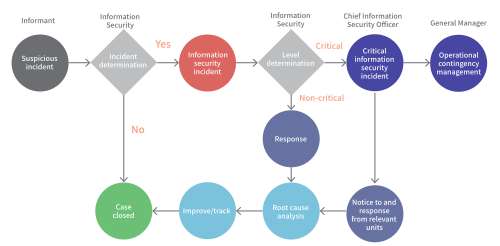
WT has a whistle-blowing system specified by the provisions of Article 23 of “Ethical Corporate Management Best Practice Principles”and Article 21 of the “Procedures for Ethical Management and Guidelines for Conduct”. Anyone who suspects or discovers a violationshould take the initiative to report it to Independent Directors, supervisors, internal audit supervisor or other appropriate person.
WT’s whistleblowing channels include an internal whistleblowe mailbox and an online whistleblowing section on the Company’s official website. These whistleblowing channels allow whistleblowers to report misconduct by Company personnel in their local language and may be used anonymously. The Auditing Office is responsible for accepting external reports, forwarding them to the heads of relevant units for investigation, and following them up until the cases are closed. The identity of the whistleblower, the content of the report, and the investigation process are kept strictly confidential. Whistleblowers are protected from improper treatment as a result of their disclosures. Complete records of the case acceptance, investigation process, and outcomes are maintained and preserved for a period of five years.
In addition, a separate whistleblower hotline and mailbox, along with a dedicated case-handling mechanism, have been established specifically for sexual harassment complaints to safeguard the privacy of complainants. If any personnel are found to have committed serious violations of ethical conduct, the Company may, depending on the circumstances, dismiss or terminate the individual in accordance with applicable laws or internal management regulations.
Furthermore, the Company regularly reiterates its whistleblowing mechanisms during annual training sessions and policy awareness programs. These include information on the reporting system, whistleblower protection against retaliation, and the designated hotline and email address for sexual harassment complaints, in order to enhance employee awareness and confidence in the reporting channels.